
Ultimo aggiornamento 14 Settembre 2026
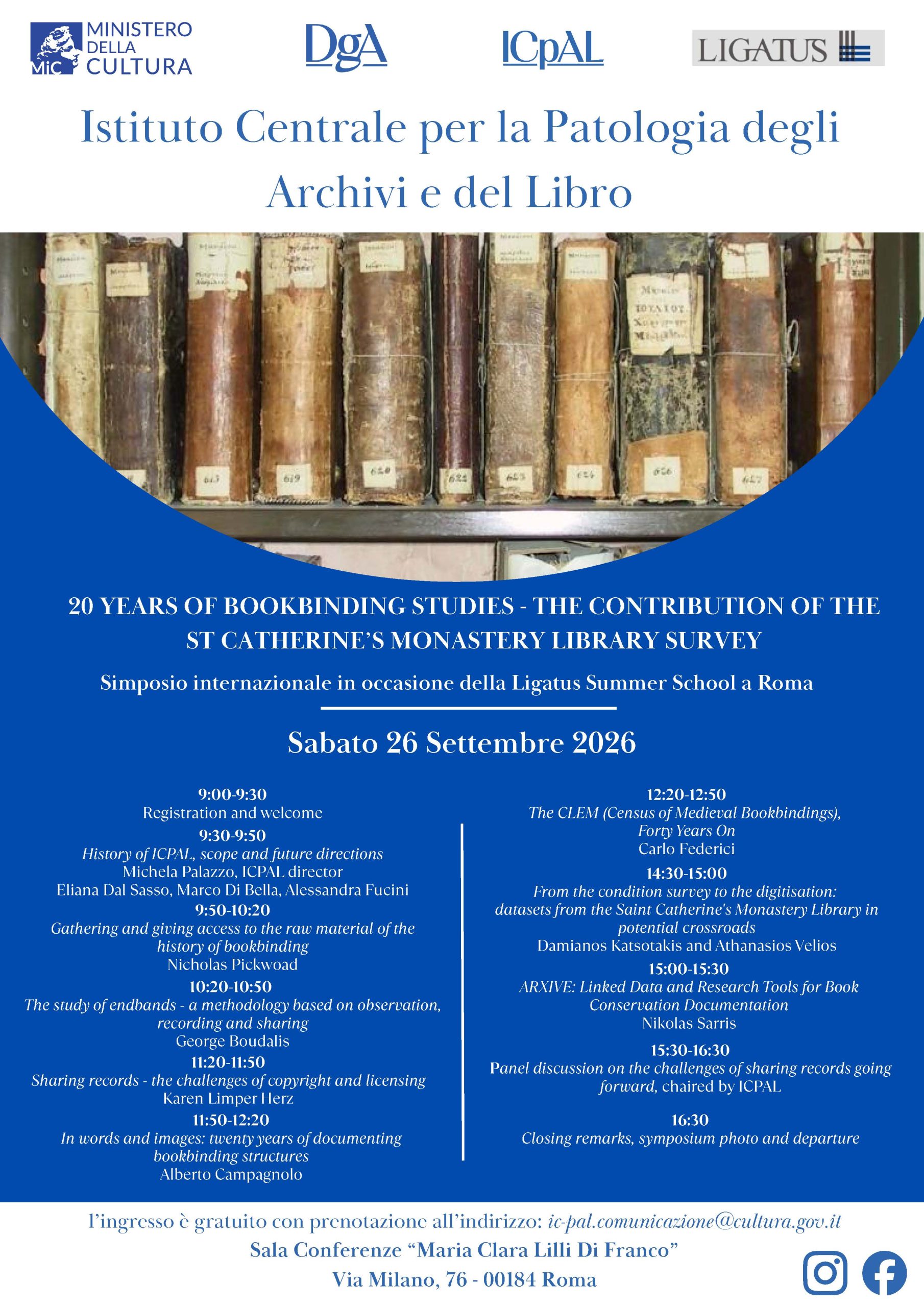
In occasione delle Giornate Europee del Patrimonio 2026 l’Istituto Centrale per la Patologia degli Archivi e del libro, in collaborazione con la Ligatus Summer School, ospiterà nella giornata di sabato 26 settembre il simposio internazionale “20 years of bookbinding studies – the contribution of the St Catherine’s Monastery Library survey”.
Nella ricorrenza del ventesimo anniversario del completamento del censimento delle legature della biblioteca del monastero di S. Caterina sul monte Sinai, restauratori, curatori, studiosi ed esperti di tecnologie informatiche avranno occasione di confrontarsi sull’importanza dei censimenti di legature e delle sfide tecnologiche legate alla realizzazione uso e conservazione di queste preziose banche dati.
PROGRAMMA:
9:00-9:30
Registration and welcome
9:30-9:50
History of ICPAL, scope and future directions.
Michela Palazzo, director of Istituto Centrale per la Patologia degli Archivi e del Libro (ICPAL)
Welcome and introductory remarks
Eliana Dal Sasso, senior conservation officer
Marco Di Bella, senior conservation officer, head of conservation and scientific researc
Alessandra Fucini, senior conservation officer
Role of ICPAL, highlight of important projects, future directions.
9:50-10:20
Gathering and giving access to the raw material of the history of bookbinding
Nicholas Pickwoad, The Institute of English Studies, University of London
10:20-10:50
The study of endbands – a methodology based on observation, recording and sharing
Georgios Boudalis, senior book conservator, codicologist, Museum of Byzantine Culture, Thessaloniki
10:50-11:20 – Coffee break
11:20-11:50
Sharing records – the challenges of copyright and licensing.
Karen Limper Herz, Head of Printed Heritage Collections at the British Library, London
11:50-12:20
In words and images: twenty years of documenting bookbinding structures
Alberto Campagnolo, KU Leuven / CESR University of Tours
12:20-12:50
The CLEM (Census of Medieval Bookbindings), Forty Years On
Carlo Federici, Associazione Italiana dei Conservatori e Restauratori degli Archivi e delle Biblioteche (AICRAB)
13:00-14:30 – Lunch break.
Several cafès, restaurants and supermarkets are within walking distance from the Institute.
14:30-15:00
From the condition survey to the digitisation: datasets from the Saint Catherine’s Monastery Library in potential crossroads
Damianos Katsotakis, Director of Imaging for the Early Manuscripts Electronic Library and Athanasios Velios, Data Manager at English Heritage and former Ligatus researcher
15:00-15:30
ARXIVE: Linked Data and Research Tools for Book Conservation Documentation.
Nikolas Sarris, Book and Paper Conservator, National Library of Greece
15:30-16:30
Panel discussion on the challenges of sharing records going forward, chaired by ICPAL
16:30
Closing remarks, symposium photo and departure.
Participation is free upon registration.
To register send an email with your full name and affiliation to:
ic-pal.comunicazione@cultura.gov.it
The symposium will be live-streamed: https://us02web.zoom.us/j/85334690561?pwd=dP9nC988CDGZbLLH06A4MOf4GyDWdu.1
Speakers and abstracts
N. Pickwoad – Gathering and giving access to the raw material of the history of bookbinding
The description of bindings has been for many years an essential part of almost all aspects of work with books, but we have still not arrived at the agreed methodology for such descriptions that is a prerequisite for making images and records of bindings available online. The happy coincidence of this year being the twentieth anniversary of both the completion of the survey of the manuscripts and early printed books in the library of the Monastery of St Catherine on Mount Sinai, and the twentieth Ligatus Summer School, held this year in Rome, combined with the hospitality generously provided by the Istituto Centrale per la Patologia degli Archivi e del Libro, which also hosts the results of the Census of Medieval Bindings, carried out between 1985 and 2002, creates an auspicious moment for us to look at where we are with regard to the description of bindings, how we got here and where we might go in the future. While there are accessible online databases dedicated to bindings, there is a mass of material held in both public and private hands which could transform our understanding of the history bookbinding if it could be made accessible. We are now also seeing advances in electronic techniques for recording binding structures which offer new and different ways of putting data in the public domain. My hope is that this symposium will explore the possibilities that lie before us to give a new prominence and better, curated, online access to bookbindings of all ages and types, with an agreed minimum level of metadata to allow them to be found. By such means we can hope to realise the potential contribution that the study of bookbinding can give to the wider study of the history of the book and its place in our cultural history.
G. Boudalis – The study of endbands – a methodology based on observation and sharing
The talk aims to briefly present the process of doing extensive research for years on the endbands used in the bookbinding traditions of the Eastern Mediterranean which culminated with the writing and illustrating of a book on the subject. Focusing on the main methodological tools of the research, the talk intends to stress the importance of combining observation, database information, analytical and synthetic thinking, manual and drawing skills to allow replicating, recording and sharing technical knowledge which is often too complicated and too difficult to communicate to the wider community of book specialists.
Georgios Boudalis is senior book conservator at the Museum of Byzantine Culture in Thessaloniki/Greece. He worked in various manuscript collections such as those of the monasteries of Mount Athos and Sinai. He completed his PhD in 2005 on the evolution of Byzantine and post-Byzantine bookbinding and has since published on issues of codicology, bookbinding archaeology and manuscript conservation. His main interests are the evolution of bookbinding techniques in the Eastern Mediterranean and how this can be studied using a combination of physical, written and iconographical evidence. He has been a visiting scholar and professor at Bard Graduate Center in New York, an invited Museum Scholar at the Getty Research Institute and is currently a member of the School of Historical Studies at the Institute for Advanced Study in Princeton. He has published two books, The codex and Crafts in Late Antiquity in 2018 and On the edge: Endbands in the Bookbinding Traditions of the Eastern Mediterranean in 2023.
K. Limper Herz – Sharing records – the challenges of copyright and licensing
When it went online in 2003, the British Library’s Database of Bookbindings was the first of its kind. Aimed at a non-specialist audience, it focussed on images and brief descriptions of binding decorations from the Middle Ages to the 21st century. Since the cyber-attack on the British Library in October 2023, the Database of Bookbindings has been unavailable, and there are ongoing discussions about how the Database will be brought back, enhanced and made freely accessible online again.
Karen Limper-Herz is Head of Printed Heritage Collections at the British Library. Mentored by Mirjam Foot and Jan Storm van Leeuwen, she has worked with and studied bookbindings from different countries and periods for several decades. She is a Fellow of the Society of Antiquaries and the Honorary Secretary and the Senior Vice-President of the Bibliographical Society (U.K.). She is a trustee of the Herzog August Bibliothek in Wolfenbüttel (Germany), a member of the organizing committee of the Arbeitskreis für die Erfassung, Erschließung und Erhaltung historischer Bucheinbände (AEB) in Berlin, and a member of the Wolfenbüttel Working Group for the History of Libraries, Books and Media. She publishes and speaks about the history of bookbinding and book collecting in the U.K. and abroad, and is a regular contributor to the “English & Foreign Bookbindings” series in The Book Collector.
A. Campagnolo – In words and images: twenty years of documenting bookbinding structures
Over the past two decades, the documentation of bookbinding structures has grown markedly richer and more connected. This paper reviews that development along two complementary lines. The first concerns how a description is represented, a long move from prose towards structured, granular data. Systematic, computerised recording of bindings goes back to the 1980s. Ligatus’s own condition survey of the library of Saint Catherine’s Monastery on Sinai carried this into a sustained methodology, feeding a dedicated XML schema and, later, the ‘Language of Bindings’, a multilingual thesaurus of binding concepts. Expressed as Linked Data, such descriptions break out of local silos and enrich wider catalogues. The second concerns the visual record, since a binding’s structure is spatial and resists description in words alone. It takes two forms. Diagrams, long drawn by hand to convey gathering and sewing, can also be generated automatically once the structure has been modelled in sufficient detail, as in VisColl, rendering complex arrangements legible at a glance. Direct imaging, by contrast, captures the object itself, where raking-light, spectral, photogrammetric and micro-tomographic techniques, once specialist and costly but increasingly affordable, bring out material features beyond ordinary perception. Together they are making the binding both more fully seen and more widely shared. The next twenty years may be less about recording bindings in isolation than about connecting everything we can now read in them.
Alberto Campagnolo is Assistant Professor in Book Archaeology at KU Leuven, where he directs the Book Heritage Lab and co-directs the VIEW Core Facility for Heritage Science and Digitisation Technologies. He is a Senior Researcher on the ERC Advanced Grant PRIMA at the Université de Tours and Editor-in-Chief of the Journal of Paper Conservation. Trained as a book conservator in Spoleto, he practised for several years in the United Kingdom and latterly at the Vatican Library; he holds a PhD from the Ligatus Research Centre (University of the Arts London) on the automated visualisation of historical bookbinding structures. He co-directs the VisColl project, and his work spans structural and material codicology, bookbinding archaeology, heritage science, and the digital humanities.
C. Federici – The CLEM (Census of Medieval Bookbindings), Forty Years On
I began planning the CLEM in 1985 and announced the project in a short article published the following year in the Gazette du livre médiéval. The article set out in detail the various stages of the census, as it was subsequently carried out over the following fifteen years.
Although no previous quantitative survey existed, the article estimated that the number of medieval bindings preserved in Italy was in the region of twenty thousand. In 2002, when the CLEM was suspended, approximately 15,000 records had been compiled, and 75–80% of the corpus had been surveyed. Each record contained detailed bibliographical information on the work, as well as structural information concerning the techniques and materials employed in the manufacture of the binding. The morphology of every tool impression stamped on the leather-covered boards was also reproduced by means of a rubbing; finally, a series of colour slides was produced documenting the various components of each binding. Unfortunately, over the past twenty years, this inexhaustible mine of information has remained out of access. Although, between 2002 and 2004, a large part of the records was digitised, in the following years the database was consigned to the drawers of the filing cabinets, where only a very few fortunate individuals were able to take a brief glimpse at it, until the drawers were finally closed for good and no one was granted access to them again. It was then said that a lightning strike (ah, Zeus!) had destroyed the digital database. Fortunately, the paper and photographic documentation had survived, although it too needed to be digitised once again.Following numerous requests, the General Directorate for Education, Research and Cultural Institutions undertook the task and brought it to completion, although, inexplicably, access to the new database has been restricted to Ministry personnel alone. Thus, even today, scholars throughout the world are unable to correlate the techniques and materials used in the manufacture of the bindings – as well as the decoration of the leather-covered boards and the images contained in the slides – with the chronological and topographical data that can be deduced from the bibliography of each work. All that remains is to hope that this important Symposium will also help to open the vaults in which the precious information on the medieval bindings preserved in Italian libraries continues to remain locked away.
Carlo Federici, after obtaining his degree in Science from the University of Rome “La Sapienza,” he continued his research as a fellow at the Institute of Geochemistry of the same university from 1972 to 1974. In 1974, he was appointed technologist at the Conservation Laboratory of the Istituto di Patologia del Libro. Four years later, he moved to the Technology Laboratory, where he was appointed head of the Section for the Archaeology of the Book, and in 1983, he became Director of the Laboratory.
Having successfully passed a competitive examination, he served as director at the Ministry of Cultural Heritage from 1987 to 2005. Between 1990 and 1992, he was Director of the Biblioteca Angelica in Rome; immediately afterward, until 2002, he led the Istituto di Patologia del Libro. From 2003 to 2005, he was head of the “Libraries and Documentary Systems” division at the Lombardy Regional Government.
He has taught at several prestigious institutions, including the Catholic University of Milan and Brescia, the University of Padua, Ca’ Foscari University of Venice, and the School of Library Science at the Vatican Apostolic Library. He coordinated the scientific program of a five-year training course for conservators of books, documents, and paper works organized by the Friuli Venezia Giulia Region and held at Villa Manin di Passariano, where he taught courses on “Theory and History of Conservation” and “History of Bookbinding.” He has led numerous national and international research teams.
From 2002 to 2004, he served as Vice-President of the International Association of Paper Historians. Within the National Research Council (CNR), he was the National Coordinator of the “Book and Documentary Heritage” sub-project of the Cultural Heritage Research Program from 1999 to 2004. Between 2004 and 2006, he directed a team at the Italo-Latin American Institute responsible for organizing two training courses for book conservators in Buenos Aires. Additionally, in December 2010, he organized and taught two courses for archivists and librarians responsible for the conservation of archival and library collections from seven South American countries, held in Buenos Aires and Montevideo.
Since its founding in 1981, he has been a member of the editorial board of the *Gazette du Livre Médiéval*, based in Paris at the Institut de Recherche et d’Histoire des Textes.
In 1992, he founded the bimonthly journal *Cabnewsletter. Conservazione negli archivi e nelle biblioteche*, serving as its editor-in-chief until July 2002. In 1998, he founded *QVINIO. International Journal on the History and Conservation of the Book*, which he also edited until 2002. In 2013, he contributed to the founding of the AICRAB (Italian Association of Conservators and Restorers of Archives and Libraries).
He has been invited to speak at numerous conferences and congresses in Italy and abroad and is the author of over 180 publications, including monographs, articles, and essays focused on the study, preservation, and enhancement of book and documents.
D. Katsotakis, A. Velios – From the condition survey to the digitisation: datasets from the Saint Catherine’s Monastery Library in potential crossroads
The library of Saint Catherine’s Monastery in Sinai, Egypt, holds a unique collection of books that provides significant evidence for the history of the Monastery and the broader region, as well as for the development of bookbinding as a craft. The collection is regularly the subject of study and has led to a number of projects documenting the books and publishing research data and observations. St. Catherine’s Monastery in collaboration with the Early Manuscripts Electronic Library (EMEL) and the University of California Los Angeles (UCLA) have published the Sinai Manuscripts Digital Library providing high resolution images of manuscripts for several of the Library’s collections. Previously the Ligatus research centre at the University of the Arts London and Camberwell College of Arts with support from the Saint Catherine Foundation produced descriptions and collected photographs of the bindings of the manuscripts and early printed books of the Library. Several other bibliographical datasets exist from earlier documentation and cataloguing projects. This contribution will highlight the value of this research material and propose their linking and cross-searching in a shared platform. A proposal of a potential technical solution will be made for data integration alongside a set of prerequisites that may enable such a project.
Damianos Kasotakis is EMEL Principal MultiSpectral Imager, he has been working for more than fifteen years in the field of digital cultural heritage. He specializes in spectral imaging of erased and rewritten manuscripts (palimpsests), as well as other damaged written materials. He is active in the field of large-scale digitization of manuscript and book collections. He has worked for the Early Manuscripts Electronic Library (U.S.A. based non-profit organization, 2011-present), MegaVision, Inc. (U.S.A. based manufacturer of specialized photographic equipment, 2021-present), and has collaborated with the UNESCO world heritage Iraq office to digitize endangered archives in Baghdad (2023).
He has trained photographers in spectral imaging both in the U.S.A. and Europe. He has worked in digitization projects among others at: St. Catherine’s Monastery of the Sinai (Egypt), libraries of monasteries on Mt. Athos (Greece), libraries in Italy (Milan, Turin, Verona, Vercelli), national libraries of Armenia, Austria, Denmark, France, Georgia, Germany, as well as the British Library, the Cambridge University Library, private collections and museums in the U.S.A.
Athanasios Velios is the Collections Data Manager at English Heritage. He trained as a conservator in Greece (Technological Educational Institute of Athens) and completed his PhD in London (Royal College of Arts, 2002) on computer applications to conservation. He worked on the St. Catherine’s condition survey project designing the project databases and documentation forms. He developed the framework for the Language of Bindings Thesaurus. He was the webmaster for the International Institute for Conservation (2008-2017) where he redeveloped the Institute’s website. He established the Documentation Network of the Institute of Conservation in the UK. He was a researcher at the University of the Arts London and the Ligatus research centre, he later became Reader in Documentation and chair of the Research Degrees Sub-committee for Camberwell, Chelsea and Wimbledon Colleges. He worked as Data Architect for the Oxford Linked Open Data pilot (OXLOD, 2018). He has been contributing to the CIDOC-CRM SIG since 2014 and was editor of the CRM version 7. Alongside Kristen St.John he co-led the Linked Conservation Data project: an AHRC-funded project to enable integration of book conservation records. He is the author of the book Working with Conservation Data.
N. Sarris – ARXIVE: Linked Data and Research Tools for Book Conservation Documentation
The growing body of digitised collections and conservation documentation offers new possibilities for investigating manuscripts and historical books, bringing together information that can support both their preservation and their scholarly interpretation. At the same time, valuable evidence is frequently dispersed across different documentation systems and formats. ARXIVE (Advanced Research and eXploration for Interoperable Value in European Heritage) is a Horizon Europe project addressing these challenges through interoperable semantic infrastructures, linked data, AI-assisted tools, and collaborative workflows developed within the European Collaborative Cloud for Cultural Heritage (ECCCH). The National Library of Greece (NLG) is one of ARXIVE’s principal pilot institutions, bringing together four complementary use cases, exploring different ways in which conservation documentation and physical evidence can be connected with digital research tools.
Nikolas Sarris is a book and paper conservator at the National Library of Greece. He has previously served as Assistant Professor of Book and Paper Conservation at the Ionian University, Greece, and as a conservator at the British Library, where he participated in the conservation project of the Codex Sinaiticus. He was also supervisor of the Conservation Laboratory at the Monastery of St John the Theologian in Patmos, where he organised the Patmos Workshops on Conservation and Historic Bookbinding (2006–2012). Since 2001, Dr Sarris has collaborated with the Ligatus Research Centre in the UK on research into historic bookbindings, particularly in connection with the St Catherine’s Library Conservation Project in Sinai. Since 2006, he has worked with the Thesaurus Islamicus Foundation on conservation and training projects at the National Library of Egypt in Cairo. He has also collaborated with Hamburg University on the EU-funded Ethio-SPARE project for the preservation and on-site conservation of Ethiopic manuscripts in Tigray, Ethiopia. Dr Sarris has worked as a UNESCO consultant and ALIPH Foundation project leader on manuscript conservation and professional training projects in Iraq, Uzbekistan and Kazakhstan. He is also an Expert Evaluator and Reviewer for the European Commission’s Horizon Europe programme. He has lectured, delivered professional workshops and published widely on book conservation, conservation documentation and historic bookbinding. He holds a PhD from the University of the Arts London, where his research focused on the decorated bookbindings of manuscripts from the Library of St Catherine’s Monastery, Sinai, Egypt.